
The word twat is one of those informal English words that means very different things depending on whether you are in the United Kingdom or the United States — and understanding this distinction is essential to using or interpreting the word correctly. Many people search for the twat meaning because they have heard it used as an insult, seen it in British comedy, or encountered it in literature and want to know exactly what it means in the context in which they found it.
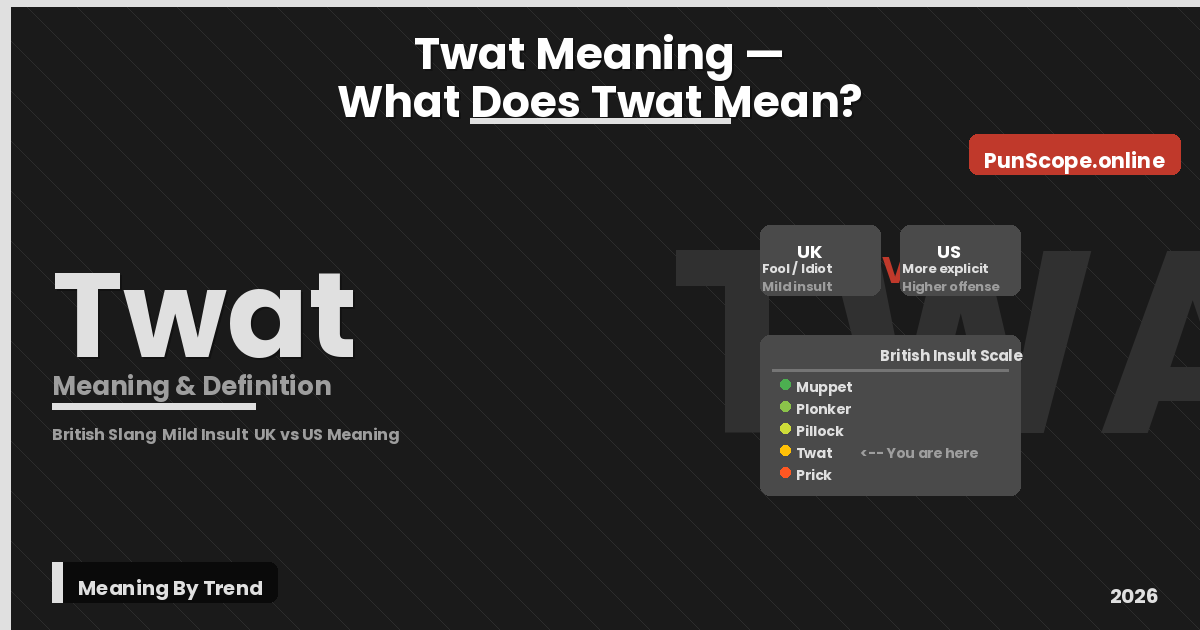
In British English, twat is most commonly used as an informal mild insult meaning a stupid, foolish, or contemptible person — broadly equivalent to words like idiot or fool, though with a slightly sharper edge. In American English, the word is more commonly understood in its older, more anatomical sense and carries considerably more weight as a vulgar term.
Whether you have encountered twat in a British sitcom, in a text message, or in a piece of literature, this complete guide will give you a thorough and precise understanding of the twat meaning across every context and variety of English in which this complicated and widely misunderstood word appears.
Table of Contents
- What Does Twat Mean in Text and Chat?
- Full Form, Stands For and Short Meaning of Twat
- Twat in British English — The Mild Insult
- Twat in American English — A Different Context
- Origin, History and First Known Use of Twat
- How People Use Twat in Daily Conversations
- Twat Across WhatsApp, Instagram, TikTok and Snapchat
- Twat in Different Fields and Contexts
- Common Confusions, Mistakes and Wrong Interpretations
- Similar Terms, Alternatives and Related Slang
- Examples of Twat in Real Chat Situations
- How to Reply When Someone Calls You a Twat
- FAQs
- Conclusion
What Does Twat Mean in Text and Chat?
In modern text messages, social media, and everyday conversation — particularly in British English — twat is most commonly used as an informal insult meaning a stupid, foolish, irritating, or contemptible person. It occupies a position in British informal vocabulary similar to words like idiot, moron, or prat — words that express mild to moderate contempt for someone’s behavior or intelligence without necessarily carrying the full weight of serious profanity.
The word’s meaning and weight differ significantly between British and American English — a crucial distinction that has caused considerable confusion and occasional embarrassment for people moving between these two varieties of the language.
Twat
noun · British and American English · informal and vulgar
In British English: an informal mild to moderate insult meaning a stupid, foolish, or contemptible person — broadly equivalent to idiot or fool, used in casual speech and frequently heard in British comedy. In American English: a vulgar anatomical term that carries considerably more weight as explicit language. The same word carries very different levels of offensiveness depending on which variety of English you are using.
For example, in British English text conversations you might see:
“He locked himself out of the house again — complete twat.”
“Don’t be such a twat about it — just apologize and move on.”
“Some twat on the motorway cut me off and then had the nerve to honk.”
Quick Chat Examples
Friend 1: “He forgot our anniversary again.” — Friend 2: “What a complete twat — you deserve so much better than that.”
“I cannot believe what that twat said in the meeting today — absolutely unbelievable.”
“Stop being a twat and just admit you were wrong for once in your life.”
Full Form, Stands For and Short Meaning of Twat
Twat is not an acronym or abbreviation — it is a complete word in its own right with a long history in the English language.
Twat
Old Norse origin · complete noun · not an acronym
Twat is a complete English word — not an initialism or abbreviation. It has two distinct primary meanings: (1) in British English informal usage, a stupid or foolish person — a mild to moderate insult; and (2) a vulgar anatomical term that is considered considerably more offensive and explicit, particularly in American English.
Short Meaning
Twat (British English) = A stupid, foolish, or irritating person — a mild to moderate informal insult frequently used in casual British speech and comedy.
Twat (American English) = A vulgar anatomical term — significantly more offensive and explicit than its British English usage.
Offense Level by Context
British English Usage
Mild to moderate insult Means: idiot / fool Common in casual speech Heard in British comedy Similar to: prat, pillock Moderate offense level
American English Usage
Vulgar and explicit Anatomical meaning dominant High offense level Not commonly used as insult Avoid in formal contexts Different cultural weight
Twat in British English — The Mild Insult
In British English, twat functions primarily as an informal insult describing a person who is being stupid, foolish, irritating, or generally contemptible in their behavior. It sits within a rich tradition of British mild insults that use colorful, occasionally vulgar-sounding words in a relatively casual and light-hearted way — a tradition that includes words like prat, pillock, numpty, muppet, divvy, muppet, and others that might sound extreme to non-British ears but are used relatively casually in everyday British speech.
In British Comedy and Media
Twat is extremely common in British television comedy, radio, stand-up comedy, and journalism. It appears in shows ranging from panel shows to sitcoms, used by comedians and commentators to describe foolish or irritating people or behavior. Its frequency in mainstream British media reflects its status as a moderately strong but not extreme piece of informal vocabulary — stronger than “idiot” but weaker than genuinely serious profanity.
Regional Variations
The word is used broadly across the United Kingdom — in England, Scotland, Wales, and Northern Ireland — though like many informal words its frequency and exact connotations vary somewhat by region. In some Northern English dialects, the word is used even more casually than in Standard British English, appearing in everyday speech without any sense of it being particularly strong or offensive.
Pronunciation Difference
Interestingly, British and American speakers pronounce the word differently — and this pronunciation difference actually reflects the different meanings each variety associates with the word. British speakers typically pronounce it to rhyme with “hat” or “cat” — while American speakers tend to pronounce it to rhyme with “hot” or “got.” This pronunciation difference is part of what makes the word’s different cultural weights so pronounced between the two varieties of English.
Twat in American English — A Different Context
In American English, the word twat is much less commonly used as a casual insult and is instead primarily understood in its more explicit anatomical meaning — which makes it a significantly more offensive and serious piece of vocabulary than it is in British English. Americans encountering the word in a British context — in British comedy, British social media, or conversation with British people — frequently experience genuine shock at how casually the word is used, precisely because their cultural association with the word is considerably more serious.
This trans-Atlantic difference has been the source of considerable linguistic discussion and occasional embarrassment — most famously in situations where British celebrities or public figures use the word on American television or in American media, creating confusion or outrage among audiences who hear it very differently from how the British speaker intended it.
Origin, History and First Known Use of Twat
Language Timeline
| Period | Development |
|---|---|
| Old Norse / Early Germanic | Root words related to slitting or cutting — precursors to the English word |
| 17th Century | First recorded appearance in English — in anatomical sense in a 1656 poem |
| 18th–19th Century | Appears in literary and vulgar texts — primarily in anatomical sense |
| Early 20th Century | British English insult meaning develops — stupid or foolish person |
| Mid 20th Century | Becomes common in British informal speech and eventually comedy |
| 2026 | Widely used in British informal English — significant trans-Atlantic meaning difference |
The word twat has a long history in English — its first recorded written appearance dates to 1656, making it one of the older pieces of vulgar vocabulary in the English language. In its earliest recorded use, it carried primarily the anatomical meaning that American English still associates with it today.
The development of the British English insult meaning — describing a stupid or foolish person — appears to have emerged in the early twentieth century through the same process of semantic extension that has given rise to many British informal insults. This process — by which an anatomical or vulgar term comes to be used as a general-purpose insult for foolish or contemptible people — is well documented in British English and has produced many similar words in the informal British vocabulary.
How People Use Twat in Daily Conversations
1. Describing Foolish Behavior
“He drove the wrong way down a one-way street — absolute twat behavior.”
“What a twat move to send that email to the entire company instead of just your team.”
2. Mild Expression of Irritation
“Some twat parked right across my driveway and left no note or number.”
“The customer was being a complete twat to the staff — I couldn’t believe the nerve.”
3. Affectionate Use Between Friends
“You forgot your own birthday plans — you absolute twat, I love you.” (affectionate ribbing)
“Classic move from the biggest twat I know — and I say that with the deepest affection.”
4. Self-Deprecating Use
“I am such a twat — I spent an hour looking for my keys and they were in my hand.”
“Complete twat moment from me — replied all on that email and now I want to disappear.”
Twat Across WhatsApp, Instagram, TikTok and Snapchat
Very commonly used in British private group chats to describe irritating people or situations — typically with more humor than genuine anger.
Example: “Some twat in the car park scratched my door and just drove off — unbelievable.”
Twitter/X
Twitter has been one of the most prominent platforms for the casual British use of twat — particularly in British political commentary and humor where it is used to describe politicians, public figures, or commentators whose behavior is considered particularly foolish or contemptible.
Example: “Absolute twat behavior from someone who really should know better by now.”
TikTok
British TikTok creators use the word relatively freely in comedy content — its casual frequency in British informal speech means it appears in rant videos, reaction content, and everyday British humor without the creators considering it particularly strong language.
Appears in British accounts’ captions and comments when expressing exasperation or mild contempt at foolish situations or behaviors — though less commonly than on Twitter due to the more visual, curated nature of Instagram content.
Twat in Different Fields and Contexts
| Context | Meaning and Usage | Offense Level |
|---|---|---|
| British casual speech | Stupid or foolish person | Mild to moderate |
| British comedy and media | Mild insult — foolish or contemptible person | Moderate — commonly heard |
| American English | Primarily anatomical — much more explicit | High — significant profanity |
| Literature and poetry | Historical anatomical usage in older texts | Contextual |
| Self-deprecating humor | Describing one’s own foolish mistake | Low — often funny |
| Formal contexts | Never appropriate — avoid entirely | Always inappropriate |
Common Confusions, Mistakes and Wrong Interpretations
1. The American-British Divide
The most significant source of confusion around twat is the dramatic difference in how British and American speakers understand and use the word. A British person using the word casually to describe a foolish driver or irritating colleague is not being as offensive as an American might assume — and an American encountering the word in British media should understand it in its British context rather than their own cultural framework.
2. Thinking It Is Always Extremely Offensive
In British English, twat is not at the extreme end of the offense spectrum — it is a moderately strong informal insult that is relatively commonly heard in casual speech, comedy, and media. It would be inappropriate in formal contexts, but it is considerably less serious in British English than American speakers often assume.
3. Using It in Formal or Professional Settings
Regardless of the British vs American distinction, twat is always informal and always inappropriate in professional, formal, or mixed audiences. The fact that it is relatively casual in British informal speech does not make it appropriate in a workplace, in public-facing communication, or in any context where formal language is expected.
4. Thinking the British Meaning Is Recent Slang
The use of twat as a British insult meaning a stupid person is not a recent development — it has been part of British informal vocabulary for the better part of a century. It is not new internet slang or a recent coinage but an established piece of British informal vocabulary with a long history in spoken English.
Similar Terms, Alternatives and Related Slang
| British Insult | Meaning | Offense Level |
|---|---|---|
| Twat | Stupid or foolish person | Moderate |
| Prat | A stupid or incompetent person | Mild |
| Pillock | A stupid, foolish, or annoying person | Mild |
| Numpty | A stupid or foolish person (Scottish English) | Mild |
| Muppet | A stupid or inept person | Very mild |
| Divvy | A stupid or foolish person | Mild |
| Plonker | A stupid or foolish person | Mild |
| Wazzock | A stupid or annoying person | Mild |
Examples of Twat in Real Chat Situations
“He spent twenty minutes arguing with the sat nav instead of just turning around — absolute twat.”
“I am such a twat — I booked the flight for the wrong month and didn’t notice until today.”
“The referee was being a complete twat — three terrible decisions in ten minutes.”
“Some twat at the self-checkout had forty items in the five items or less lane. Forty items.”
“He came to the fancy dress party as himself — absolute twat energy and we love him for it.”
“Do not be a twat about this — just talk to her and sort it out like an adult.”
“I locked my phone with a new PIN and immediately forgot it. I am a colossal twat.”
“Classic twat move — turned up two hours late and then complained about his cold food.”
Quick Scenario
Friend: “I accidentally sent my boss the message meant for you saying how boring the meeting was.” — You: “Oh you absolute twat. What did he say? 😭”
How to Reply When Someone Calls You a Twat
If It Is Clearly Affectionate
“I know, I know — I outdid myself this time.”
“Honestly fair — I cannot argue with that assessment.”
If It Is Genuine Annoyance
“That is a bit harsh — I made one mistake.”
“I understand you are annoyed — let me explain what happened.”
If It Is Playful Banter
“Takes one to know one, mate.”
“Coming from you that is practically a compliment.”
FAQs
What does twat mean in British slang?
In British slang, twat means a stupid, foolish, or irritating person — a mild to moderate insult used casually in everyday British speech. It is broadly equivalent to words like idiot, prat, or pillock in terms of its offense level in British English. The word is commonly heard in British comedy, casual conversation, and social media — considerably more casual in British English than in American English where the word carries a very different and more serious meaning.
Is twat a very bad word?
This depends entirely on which variety of English you are using. In British English, twat is a moderately strong informal insult — stronger than mild words like idiot but not at the extreme end of British profanity. It is inappropriate in formal or professional contexts but relatively common in casual British speech and comedy. In American English, the word carries considerably more weight as it is primarily understood in its explicit anatomical sense — making it significantly more offensive and serious in American cultural contexts.
Why do British people say twat so casually?
British people use twat relatively casually because in British informal English, the word primarily means a stupid or foolish person — a meaning that has developed over the better part of a century in British speech. British informal vocabulary includes a range of words that might sound more shocking to outside ears but function as relatively mild insults within British cultural context. The casual use of twat in British speech reflects this established cultural positioning of the word within the British informal vocabulary.
What is the American equivalent of the British use of twat?
In terms of offense level and usage pattern, the closest American English equivalents to the British English insult use of twat would be words like jerk, moron, or idiot — informal insults describing a stupid or contemptible person, used casually in everyday speech without necessarily carrying extreme offense. The British use of twat in this sense is considerably milder than the American association with the word would suggest.
Is twat appropriate for everyday use?
In British informal contexts between people who know each other well, twat is relatively commonly used without causing serious offense — similar to calling someone an idiot or a fool. However, it is never appropriate in professional, formal, or public contexts, and it should always be used with awareness of who you are speaking to and what their cultural background is. The word’s dramatically different weight in American English means it requires particular care in any trans-Atlantic context.
Conclusion
The twat meaning is a genuinely fascinating case study in how the same word can carry dramatically different weight, offense levels, and cultural significance depending on which variety of English you are using and the cultural context you bring to it. In British English, twat is a moderately strong informal insult meaning a stupid or foolish person — common in casual speech, widely heard in comedy, and considerably less serious than American speakers typically assume.
In American English, the word carries a very different and considerably more explicit primary association. Understanding both dimensions of the twat meaning — and most importantly, understanding the crucial British-American distinction — gives you the complete picture of one of the English language’s most culturally interesting and frequently misunderstood informal words, and the awareness to use and interpret it correctly in whatever context you encounter it.