
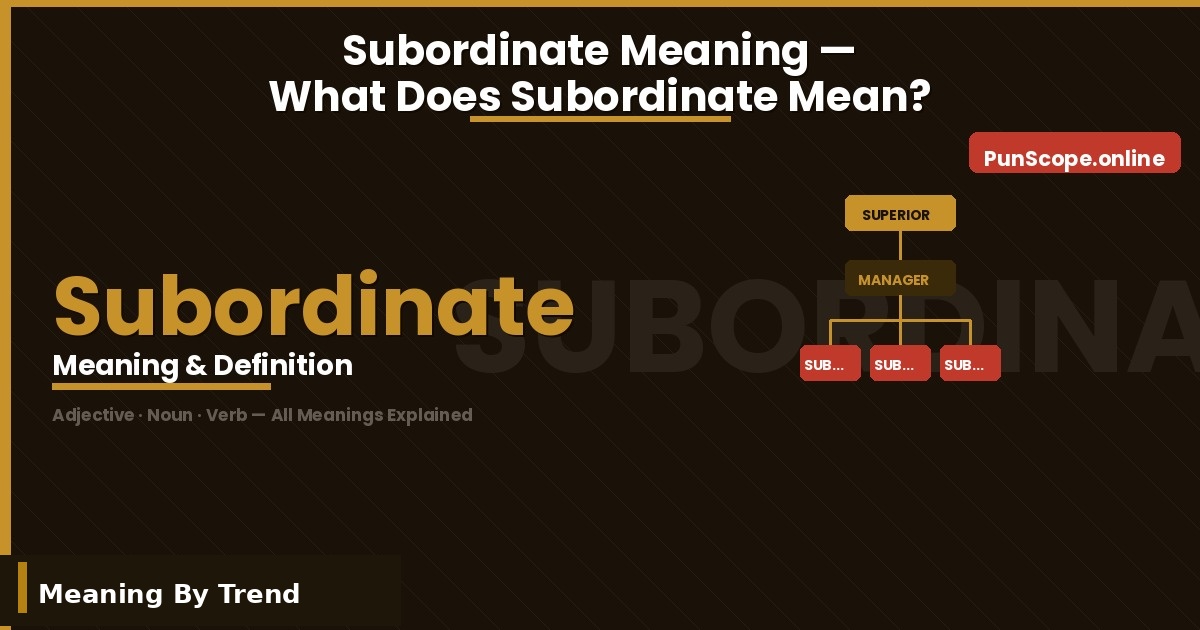
The word subordinate is one of the most important and widely used words in professional, academic, and everyday English — appearing in business, grammar, law, military, and social contexts with a consistent core meaning of something or someone that is lower in rank, importance, or authority. Understanding the full subordinate meaning will give you the confidence to use this essential word accurately across every context in which it appears.
Table of Contents
- What Does Subordinate Mean?
- Subordinate as an Adjective
- Subordinate as a Noun
- Subordinate as a Verb
- Subordinate in the Workplace
- Subordinate in Grammar
- Subordinate in Different Contexts
- Synonyms and Antonyms
- Subordinate in a Sentence
- Origin and Etymology
- Subordinate vs Inferior vs Junior
- FAQs About Subordinate
- Conclusion
What Does Subordinate Mean?
Subordinate
adjective / noun / verb · Latin origin · subordinatus
Subordinate means lower in rank, importance, authority, or position relative to someone or something else. As a noun, a subordinate is a person who works under the authority or supervision of another. As a verb, to subordinate something means to treat it as less important than something else or to place it under the control of another.
The word subordinate functions in English as an adjective, a noun, and a verb — making it one of the most grammatically versatile words in the language. In all three of its grammatical roles, subordinate carries the same essential core meaning: lower in rank, secondary in importance, or placed under the authority of something or someone else. This consistent core meaning makes subordinate one of the most precise and useful words in English for describing hierarchical relationships across virtually every domain of human activity.
Key Insight
Subordinate is one of the rare English words that works as an adjective, a noun, AND a verb — each with the same core idea of being lower in rank or importance. Note that the pronunciation changes slightly: as an adjective or noun it is sub-OR-din-it, while as a verb it is sub-OR-din-ATE.
Subordinate as an Adjective
As an adjective, subordinate describes something or someone that is lower in rank, less important, or under the authority of something or someone else. When you describe a position, role, or idea as subordinate, you are saying that it occupies a secondary or lesser place in a hierarchy or order of importance.
Key Uses as Adjective
In an organizational context, a subordinate role is one that reports to and takes direction from a higher-ranking position. In a logical or academic context, a subordinate idea or concern is one that is secondary to the main point or purpose — something that matters, but matters less than the primary focus. In grammar, a subordinate clause is one that depends on a main clause and cannot stand alone as a complete sentence.
Subordinate as a Noun
As a noun, a subordinate is a person who is under the authority, supervision, or command of another person. In a workplace, military, or organizational context, your subordinates are the people who report to you — the people whose work you oversee and for whose performance you are responsible.
The noun subordinate is used across virtually every professional and organizational context. A manager has subordinates — the team members who report to them. A military officer has subordinates — the soldiers or officers of lower rank who serve under their command. A senior partner has subordinates — the junior associates and staff who work under their direction and authority.
Important Nuance
While the word subordinate is perfectly accurate and widely used in professional contexts, it is worth noting that in modern workplace culture, many managers and leaders prefer softer language such as “team members,” “direct reports,” or “staff” when referring to the people who work under them, as subordinate can feel somewhat impersonal or hierarchically cold in certain organizational cultures that emphasize flat structures and collaborative working relationships.
Subordinate as a Verb
As a verb, to subordinate something means to treat it as less important than something else, to place it in a secondary position, or to bring it under the control or authority of another. When you subordinate one concern to another, you are consciously deciding that the second concern takes priority over the first.
She subordinated her personal ambitions to the needs of her family during those difficult years.
The government subordinated economic concerns to the immediate need for public health measures.
In his philosophy, individual freedom must never be subordinated to the demands of the state.
The verb form of subordinate is particularly common in philosophical, political, and ethical discussions where competing priorities and values must be weighed against each other and some placed above others in terms of importance and urgency.
Subordinate in the Workplace
In workplace and organizational contexts, subordinate is perhaps most commonly encountered as a noun describing the hierarchical relationship between managers and those who report to them. Understanding this relationship is fundamental to how most organizations structure their operations and accountability.
Manager and Subordinate Relationship
The relationship between a manager and their subordinates is one of the most studied and discussed dynamics in organizational psychology and business management. A good manager treats their subordinates with respect, fairness, and genuine concern for their development and wellbeing, while also maintaining the clarity of authority and accountability that organizational structures require. A poor manager may abuse the power differential inherent in the subordinate relationship, treating those below them dismissively or unfairly.
Subordinate in Organizational Charts
In formal organizational charts (org charts), subordinate relationships are typically depicted by lines connecting higher-level positions to lower-level ones, with the person or role at the top of the line having authority over those beneath it. Every box on an org chart that sits below another box is in a subordinate position relative to the box above it.
Subordinate in Grammar
In English grammar, the word subordinate appears most commonly in the term subordinate clause — one of the most important concepts in understanding how complex sentences are constructed.
What Is a Subordinate Clause?
A subordinate clause (also called a dependent clause) is a group of words that contains a subject and a verb but cannot stand alone as a complete sentence because it does not express a complete thought on its own. A subordinate clause depends on a main clause (independent clause) to give it full meaning, and it is introduced by a subordinating conjunction such as because, although, when, while, if, since, unless, or after.
Because she studied hard — this is a subordinate clause. It needs a main clause: “Because she studied hard, she passed the exam.”
Although it was raining — subordinate clause. Full sentence: “Although it was raining, they went for a walk.”
When the meeting ended — subordinate clause. Full sentence: “When the meeting ended, everyone left quickly.”
Subordinate in Different Contexts
| Context | Meaning of Subordinate | Example |
|---|---|---|
| Workplace | Person who reports to a manager | “She manages a team of six subordinates.” |
| Military | Lower-ranking soldier or officer | “The general gave orders to his subordinates.” |
| Grammar | A dependent clause needing a main clause | “Because it rained” is a subordinate clause. |
| Philosophy | Secondary in importance to something else | “Rights were subordinated to state security.” |
| Law | Lower in legal authority or jurisdiction | “The subordinate court deferred to the higher.” |
| General | Lower in rank or importance | “Style is subordinate to substance in great writing.” |
Subordinate Synonyms and Antonyms
Synonyms of Subordinate
Junior Inferior Assistant Underling Deputy Secondary Lesser Lower-ranking Dependent Subsidiary Ancillary Minor
Antonyms of Subordinate
Superior Senior Manager Chief Primary Dominant Head Leader Boss Director Principal Independent
Subordinate in a Sentence — Real Examples
As a manager, it is your responsibility to support and develop your subordinates, not simply to direct them.
The subordinate clause “because he was tired” cannot stand alone as a complete sentence.
In the military hierarchy, every officer has both superiors and subordinates to whom they are accountable.
She refused to subordinate her professional judgment to the demands of a client she believed was wrong.
Personal comfort must sometimes be subordinated to the greater needs of the team and the mission.
The regional manager oversees four area managers, each of whom has their own subordinates to manage.
In his organizational philosophy, no one is truly subordinate — everyone has a role of equal dignity and importance.
The court ruled that local ordinances were subordinate to the requirements of national legislation.
A good leader never makes their subordinates feel small or unimportant — quite the opposite.
The subordinate role in the partnership was not glamorous, but it was absolutely essential to the project’s success.
She learned quickly that being someone’s subordinate did not mean having to abandon her own professional values.
In complex sentence structures, subordinate clauses add depth and nuance to the main idea being expressed.
Origin and Etymology of Subordinate
The word subordinate comes from the Medieval Latin word subordinatus, which is the past participle of the verb subordinare — meaning to place in a lower order or rank. This Latin verb is formed from two parts: the prefix sub-, meaning under or below, and the verb ordinare, meaning to arrange, to order, or to put in order — which itself comes from the Latin ordo, meaning order, rank, or arrangement.
The word entered English in the fifteenth century, initially used primarily in hierarchical and organizational contexts to describe things or people placed in a lower rank or order. Over subsequent centuries its usage broadened to encompass grammatical subordinate clauses, philosophical discussions of competing priorities, and the full range of modern professional and academic contexts in which it is now so widely encountered.
The root ordo — meaning order or rank — is the same root that gives English words like ordinary, orderly, coordinate, and inordinate, all of which share the underlying concept of arrangement, rank, and order that is central to the meaning of subordinate.
Subordinate vs Inferior vs Junior — Key Differences
| Word | Core Meaning | Tone / Connotation |
|---|---|---|
| Subordinate | Lower in organizational rank or authority | Neutral and formal — used in professional and academic contexts |
| Inferior | Lower in quality, rank, or importance | Often negative — can imply lesser quality or worth, not just rank |
| Junior | Lower in seniority or experience | Neutral and common — widely used in professional settings without negative tone |
| Underling | A person of lower rank who takes orders | Informal and slightly dismissive — implies a power imbalance |
| Deputy | A person who assists and stands in for a superior | Positive — implies trust and delegated authority |
FAQs About Subordinate Meaning
What does subordinate mean in simple terms?
In simple terms, subordinate means lower in rank, less important, or under the authority of someone or something else. A subordinate person is someone who works under and reports to a more senior person. A subordinate idea or concern is one that is secondary in importance to the main focus.
What is a subordinate in the workplace?
In the workplace, a subordinate is a person who reports to and works under the supervision and authority of a manager or more senior colleague. If you are a manager, your subordinates are the members of your team whose work you oversee and for whose performance you are responsible. The term is formal and neutral, though many modern workplaces prefer terms like “direct reports” or “team members.”
What is a subordinate clause in grammar?
A subordinate clause in grammar is a group of words that contains a subject and a verb but cannot stand alone as a complete sentence — it depends on a main clause for its full meaning. Subordinate clauses are introduced by subordinating conjunctions like because, although, when, if, since, and unless. For example, “because she was late” is a subordinate clause that needs a main clause like “she missed the meeting” to form a complete sentence.
Can subordinate be used as a verb?
Yes — subordinate is frequently used as a verb meaning to treat something as less important than something else or to place it under the authority or control of another. For example, you might say “he subordinated his personal interests to the needs of the team” — meaning he deliberately placed team needs above his own personal interests in order of priority.
Is subordinate a negative word?
Subordinate is not inherently negative — it is a neutral descriptive word that simply describes a hierarchical position or relationship. In professional and academic contexts it is completely neutral. However, in personal interactions, calling someone your subordinate can sound cold or impersonal, which is why many modern professionals prefer warmer alternatives like “team member” or “colleague” in everyday conversation.
What is the noun form of subordinate?
Subordinate itself is the noun form — a subordinate is the person. The abstract noun describing the quality or state of being subordinate is subordination. For example — “the subordination of individual interests to collective goals is a key principle of this organization’s philosophy.”
Conclusion
The word subordinate is one of the most precise, versatile, and widely used words in English for describing hierarchical relationships — whether between people in an organization, ideas in an argument, clauses in a sentence, or values in a philosophical framework. Whether you use it as an adjective to describe a lower-ranking position, as a noun to refer to a team member who reports to you, or as a verb to describe placing one concern below another in order of priority, understanding the full subordinate meaning gives you a powerful and precise tool for navigating the language of authority, hierarchy, and organizational life. From its Latin roots in sub and ordinare to its thoroughly modern applications in business, grammar, law, and philosophy, subordinate remains one of the most essential and expressive words in the English language.