
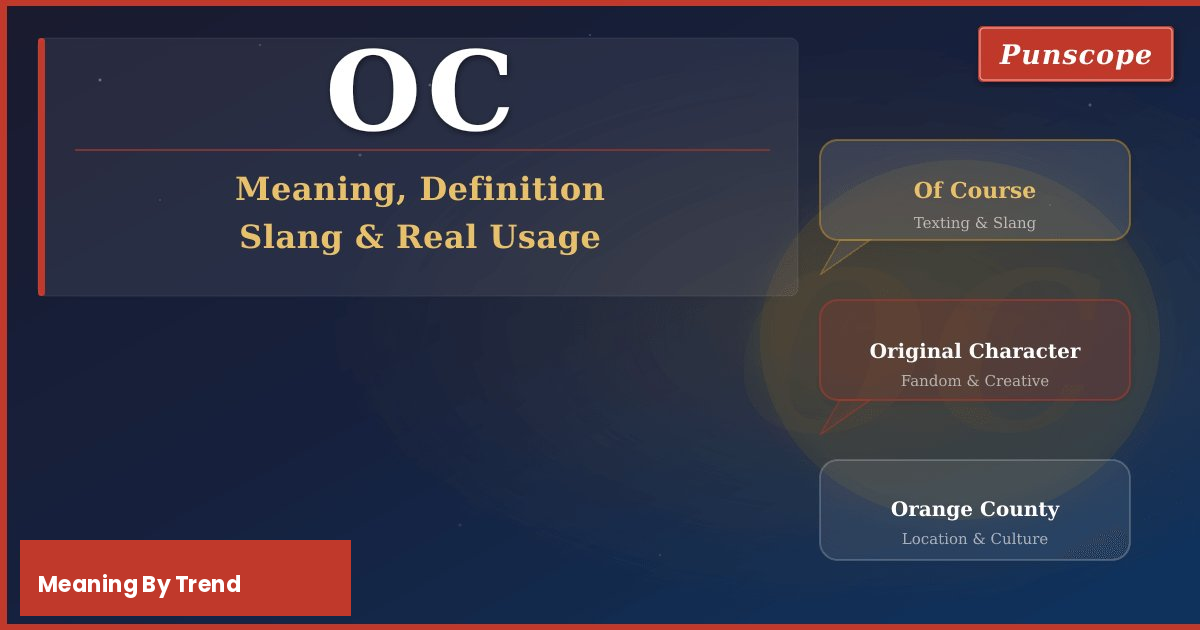
01. Introduction — What Does OC Mean?
If you have ever scrolled through social media, browsed a fan fiction forum, or sent a casual text message, chances are you have encountered the abbreviation OC at some point — and perhaps found yourself wondering exactly what it means. The truth is that OC meaning is not a single, fixed definition. Rather, OC is one of those wonderfully versatile abbreviations in modern English that carries several distinct meanings depending entirely on the context in which it is used. From a simple affirmation in casual texting to a deeply creative concept in fan communities, from a famous American county to a wide range of professional and technical uses, OC is everywhere in contemporary communication — and understanding its full range of meanings will make you a far more fluent reader and writer of modern English.
Table of Contents
- Introduction — What Does OC Mean?
- OC Meaning: Of Course
- OC Meaning: Original Character
- OC Meaning: Orange County
- Other Meanings of OC
- OC in Social Media & Texting
- OC in Fandom & Creative Communities
- History & Origin of OC
- How to Use OC Correctly
- 20 Example Sentences Using OC
- Common Mistakes & Misunderstandings
- Synonyms & Alternatives to OC
- OC Across Different Contexts
- Expert Tips for Using OC
- OC in 2026 — Trending Usage
- Frequently Asked Questions
- Conclusion
02. OC Meaning: Of Course
The most widely used OC meaning in everyday texting and informal digital communication is “Of Course.” In this context, OC functions as a quick, casual affirmative — a way of saying “yes, absolutely” or “that goes without saying” without typing out the full phrase. This usage is especially common in text messages, instant messaging platforms such as WhatsApp and Telegram, and social media comments where brevity is valued and speed of communication is prioritised.
When someone asks a favour or makes a request and you respond with OC, you are signalling agreement, willingness, and often a sense of ease — as if the request is so reasonable that it barely needed asking. This makes OC a warmer, more casual alternative to a simple “yes” or “sure,” carrying a connotation of generosity and openness. It is the digital equivalent of a shrug and a smile — “of course, no problem at all.”
“When your friend asks if you are coming to the party and you reply OC — that single abbreviation communicates not just agreement, but enthusiasm and warmth.”
Example Usage — OC as “Of Course”
“Can you help me with this?” — “OC! What do you need?”
“Are you still coming tonight?” — “OC, wouldn’t miss it.”
“Did you enjoy the film?” — “OC, it was brilliant.”
03. OC Meaning: Original Character
The second major OC meaning — and arguably the one with the richest creative tradition behind it — is “Original Character.” This usage is deeply embedded in fan communities, creative writing circles, and online fandom culture, where it refers to a fictional character created entirely by a fan or writer rather than borrowed from an existing story, film, game, or television series. When someone in a fan fiction forum says “I wrote a story featuring my OC,” they mean a character they invented themselves — one who does not appear in any official canon and exists solely through their own imagination and creative effort.
The concept of the OC in fandom culture is both celebrated and sometimes controversial. On one hand, creating an OC is seen as a mark of genuine creative investment — a writer or artist who goes beyond simply reimagining existing characters to build something entirely new. On the other hand, poorly conceived OCs — particularly those who are seen as overpowered, wish-fulfillment figures — are sometimes dismissed as “Mary Sues” or “Gary Stus,” terms for characters who are so perfect and capable that they strain credibility and fail to create genuine narrative tension.
A well-crafted OC, however, can be an extraordinary achievement — a fully realised character with their own backstory, motivations, flaws, relationships, and arc, who enriches the world they inhabit rather than overshadowing it. The best OCs feel as real and as compelling as any canonical character, and some have developed passionate followings of their own within their respective fandoms.
Example Usage — OC as “Original Character”
“I spent months developing my OC — she has a full backstory, unique powers, and a complicated relationship with the main cast.”
“The fan fiction features three OCs alongside the canonical characters from the original series.”
“His OC is so well-written that readers often forget she is not part of the official story.”
04. OC Meaning: Orange County
A third well-established OC meaning is “Orange County” — specifically Orange County, California, one of the most famous and densely populated counties in the United States. Located in Southern California between Los Angeles County to the north and San Diego County to the south, Orange County is home to cities including Anaheim, Irvine, Santa Ana, and Huntington Beach, and is internationally recognised as the location of Disneyland, one of the world’s most visited theme parks.
The abbreviation OC became particularly associated with Orange County in popular culture following the success of the television series The O.C., which aired from 2003 to 2007 and brought the affluent, sun-drenched lifestyle of the region to global attention. The show made “The OC” a cultural shorthand not just for a geographic location but for a particular aesthetic — wealthy, coastal, glamorous, and occasionally troubled beneath the surface.
Today, OC as Orange County is used widely in news reporting, real estate, travel writing, and casual conversation among Californians and those familiar with the region. It is a clean, efficient abbreviation that communicates a very specific sense of place and culture to those in the know.
05. Other Meanings of OC
Beyond the three primary meanings discussed above, OC carries a range of additional meanings across different professional, technical, and cultural contexts. Understanding this broader spectrum of the OC meaning ensures you are never caught off guard when the abbreviation appears in an unfamiliar setting.
In military and law enforcement contexts, OC most commonly stands for Oleoresin Capsicum — the active chemical compound in pepper spray, derived from hot peppers. When officers refer to deploying OC spray, they mean pepper spray, which is a non-lethal crowd control and self-defence tool used worldwide. This usage is standard across law enforcement training manuals, incident reports, and operational communications.
In business and organisational settings, OC can stand for Organisational Chart — a visual representation of a company’s hierarchy and reporting structure. In medical contexts, OC frequently abbreviates Oral Contraceptive, referring to birth control pills. In computing and technology, OC can stand for Overclocking — the practice of running a processor or graphics card faster than its officially rated speed to improve performance.
06. OC in Social Media & Texting
In the world of social media and digital communication, the OC meaning most commonly encountered is “Of Course” — but the abbreviation also carries a second important meaning in these spaces: “Original Content.” On platforms such as Reddit, Twitter/X, TikTok, and Instagram, content creators and community members use OC to flag that what they are sharing is something they created themselves rather than reposting or sharing from another source.
When a Reddit user posts a photograph, artwork, meme, or video and tags it as OC, they are asserting authorship — claiming that this is their own original work and not borrowed, stolen, or reposted from elsewhere. This usage reflects the broader culture of content creation on social media, where originality is valued and attribution matters. Flagging a post as OC invites a different kind of engagement from the audience — rather than discussing the content in isolation, viewers often want to know more about the creator, their process, and their other work.
Example Usage — OC as “Original Content”
“Just finished this painting — posting as OC so you know it is all mine.”
“This is my first OC post on this subreddit — took me three weeks to film and edit.”
“Always tag your work as OC so people know you created it.”
07. OC in Fandom & Creative Communities
The OC meaning of “Original Character” has given rise to an entire ecosystem of creative practice within online fan communities. Creating, developing, and sharing OCs is a central activity on platforms such as DeviantArt, Archive of Our Own (AO3), Tumblr, and Wattpad, where writers and artists invest enormous creative energy into building characters who feel as rich and fully realised as those in any professionally published work.
An OC in fandom typically comes with a detailed character sheet — a document outlining the character’s appearance, personality, backstory, abilities, relationships, and motivations. The level of detail that dedicated creators pour into their OCs can be extraordinary, encompassing everything from childhood trauma and formative relationships to specific speech patterns and aesthetic preferences. For many creators, their OC becomes a vehicle for personal expression, allowing them to explore aspects of their own identity, experiences, and values through a fictional lens.
The relationship between an OC and the existing canonical world they inhabit — whether that is the Marvel universe, the Harry Potter wizarding world, or the world of a beloved video game — is one of the most fascinating dynamics in fan creativity. The best OCs do not simply exist alongside the canonical story; they illuminate it, challenge it, and expand it in ways that feel authentic to the original vision while adding something genuinely new.
08. History & Origin of OC
The history of the abbreviation OC reflects the broader evolution of written communication in the English-speaking world. The use of OC to mean “of course” almost certainly predates the digital era, with written abbreviations of common phrases having a long history in personal correspondence, telegrams, and shorthand writing systems. However, it was the explosion of text messaging in the late 1990s and early 2000s that transformed OC and dozens of similar abbreviations into everyday vocabulary for millions of people.
The OC meaning of “Original Character” emerged slightly later, developing organically within online fan fiction communities in the late 1990s as the internet made it easy for fans to share their creative work with global audiences. As fan fiction communities grew in size and sophistication on platforms like FanFiction.net and later AO3, the vocabulary of fandom — including the term OC — became increasingly standardised and widely understood.
The association of OC with Orange County, California, gained significant cultural momentum with the premiere of The O.C. television series in 2003, which introduced the abbreviation to audiences worldwide and cemented its place in popular culture as a geographic and lifestyle shorthand.
09. How to Use OC Correctly
Using OC correctly depends entirely on understanding the context in which it appears. The golden rule of OC meaning is this: always read the surrounding context before assuming you know which definition applies. A message from a friend asking “OC?” means something very different from a Reddit post tagged as OC, which in turn means something very different from a character description in a fan fiction forum tagged as featuring an OC.
In casual texting and messaging, OC for “of course” works best in informal, friendly exchanges. It carries a light, easy tone that suits casual conversation but would be out of place in a professional email or formal written communication. If you are writing to a colleague, a client, or anyone in a professional context, always spell out “of course” in full — the abbreviation signals a level of informality that may be inappropriate in such settings.
In creative and fan community contexts, always be clear about which meaning of OC you intend when introducing the abbreviation. If you are posting original content, tag it clearly. If you are discussing an original character, provide enough context — a character name, a brief description — so that readers understand immediately who or what you are referring to. Clarity is especially important when your OC appears alongside canonical characters, where the distinction between “my invented character” and “an existing character from the source material” needs to be immediately apparent.
10. 20 Example Sentences Using OC
The best way to fully internalise the range of OC meaning is to see it in action across a variety of contexts. The following twenty sentences demonstrate how OC functions in real-world usage across its most common meanings.
OC as “Of Course”
1. “Are you joining us for dinner?” — “OC, I will be there at seven.”
2. “Can I borrow your notes?” — “OC! I will send them right now.”
3. “You remembered my birthday!” — “OC I did — how could I forget?”
4. “Is it okay if I bring a friend?” — “OC, the more the merrier.”
5. “Did you enjoy the concert?” — “OC, it was incredible.”
OC as “Original Character”
6. “My OC has been in development for over a year — she finally feels complete.”
7. “The story features two OCs who interact with the main cast from the original series.”
8. “He posted detailed character art of his OC alongside a full backstory document.”
9. “My OC was originally designed as a minor side character, but readers loved her so much she became a protagonist.”
10. “Writing an OC for this fandom was the most creative challenge I have ever set myself.”
OC as “Original Content” / Other Meanings
11. “All the photography on this account is OC — I take every shot myself.”
12. “This illustration is OC — please do not repost without crediting me.”
13. “Growing up in the OC meant beaches, sunshine, and endless summer.”
14. “The report included an OC showing the new management structure.”
15. “Officers deployed OC spray to disperse the crowd safely.”
16. “He spent the weekend OC-ing his graphics card to improve gaming performance.”
17. “The doctor discussed switching to a new OC as part of the treatment plan.”
18. “Real estate prices in the OC have risen sharply over the past five years.”
19. “She tagged the video as OC to make clear she had filmed and edited it entirely herself.”
20. “The fandom has an entire wiki dedicated to fan-created OCs set in the same universe.”
11. Common Mistakes & Misunderstandings
The most common mistake people make with OC meaning is assuming that there is only one correct interpretation — and proceeding confidently on that assumption without considering the context. Because OC carries so many distinct meanings across different communities and platforms, context-blindness is the single biggest source of confusion. Someone unfamiliar with fan fiction culture might read an OC tag in a creative writing forum and assume it means “of course” — only to find themselves completely lost when the text that follows describes a character’s appearance and backstory in detail.
A second common mistake is using OC for “of course” in professional or formal communications. In a business email, a report, or any formal document, abbreviations like OC are out of place and may read as unprofessional or careless. Always spell out “of course” in full in formal writing — the two seconds you save by abbreviating are not worth the impression of sloppiness you might create.
In creative communities, a common misunderstanding is conflating an OC (Original Character) with a self-insert — a character who is essentially a fictional version of the author themselves. While all OCs carry some degree of personal investment from their creator, a true OC is a distinct fictional entity with their own identity, not simply a stand-in for the writer. Making this distinction clear in your creative work helps maintain the integrity of the OC and makes for more compelling storytelling.
12. Synonyms & Alternatives to OC
Depending on which OC meaning you are working with, there are a range of synonyms and alternatives available. For OC as “of course,” common alternatives in informal texting include “obv” (obviously), “def” (definitely), “sure,” “yep,” “absolutely,” “100%,” and the simple affirmative “yes.” Each of these carries slightly different connotations — “absolutely” is more emphatic, “sure” is more casual, “100%” signals enthusiastic agreement — so choosing the right alternative depends on the tone you want to convey.
For OC as “Original Character,” there is no perfect single-word synonym in standard English — the concept is specific enough that the term OC itself has become the standard vocabulary within the communities that use it. You might describe the same idea as a “fan-created character,” a “non-canonical character,” or a “self-invented character,” but none of these phrases carries quite the same weight and cultural resonance as OC within fandom communities.
For OC as “Original Content,” alternatives include “OG content” (though this has slightly different connotations), “self-produced content,” “creator content,” or simply “my work.” On platforms with specific tagging conventions, the OC tag has become so standard that no direct synonym is commonly used — it is simply the expected way to flag self-created work.
13. OC Across Different Contexts
The versatility of the OC meaning across different contexts is both its greatest strength and its greatest potential source of confusion. In casual texting between friends, OC is almost universally understood as “of course” and rarely causes any ambiguity. In creative and fan communities, OC almost always signals an original character or original content, and anyone familiar with those communities will decode it immediately. In a California real estate listing or a news article about Southern California, OC almost certainly refers to Orange County.
The interesting cases are those where contexts overlap or collide — where someone steeped in fandom culture receives a message from a friend using OC casually, or where a law enforcement professional and a social media creator both encounter the abbreviation in the same online space. In these moments, the reader’s background and familiarity with different communities shapes how they decode the abbreviation, and misunderstandings — however minor — are inevitable.
The solution is not to avoid OC but to be thoughtful about when and where you use it, and to provide enough surrounding context that your intended meaning is immediately clear. This is good communication practice in general — never assume that your audience shares your vocabulary, especially when that vocabulary includes abbreviations with multiple possible meanings.
14. Expert Tips for Using OC
Mastering the OC meaning in all its forms comes down to a few key principles that will serve you well across any context in which the abbreviation appears. First and most importantly: always read the full context before assuming you know which meaning applies. A single abbreviation at the beginning of a message or post tells you very little — the words, images, and community norms surrounding it tell you everything.
Second, when using OC yourself, err on the side of clarity. If you are tagging content as OC to mean original content, make sure your platform and audience will understand that convention — not all communities use it the same way. If you are introducing an original character in your creative writing, spell out “Original Character” at least once before switching to the abbreviation, especially if your audience includes readers who may be unfamiliar with fandom vocabulary.
Third, be aware of register and formality. OC for “of course” belongs firmly in informal, casual communication — texting, social media, instant messaging. The moment you move into professional, academic, or formal written communication, the abbreviation should disappear and the full phrase should take its place. This sensitivity to register is one of the markers of genuine language fluency, and it applies to all abbreviations and slang, not just OC.
15. OC in 2026 — Trending Usage
In 2026, the OC meaning continues to evolve as digital communication platforms grow more sophisticated and fan communities become increasingly mainstream. The “of course” usage remains the most common in everyday texting and messaging, but the “original character” and “original content” meanings have gained significantly in cultural visibility as creative communities move from niche online spaces to mainstream platforms.
The rise of AI-generated content has given new urgency to the OC tag on social media platforms, where creators use it to signal that their work is genuinely human-made rather than computer-generated. In an era of increasing concern about AI content flooding digital spaces, tagging work as OC has taken on new meaning as a declaration of authentic human creativity — a badge of honour in a landscape increasingly shaped by algorithms and automation.
In fandom communities, the tradition of the OC continues to flourish, with new platforms and tools making it easier than ever for creators to develop, visualise, and share their original characters. The growing acceptance of fan creativity in mainstream culture — reflected in the success of officially licensed fan works and the increasing recognition of fan communities by major media companies — has elevated the status of the OC from a niche creative exercise to a genuinely respected form of artistic expression.
Frequently Asked Questions — OC Meaning
What is the most common OC meaning in texting?
The most common OC meaning in texting and casual digital communication is “Of Course.” It is used as a quick, informal affirmative — a way of agreeing enthusiastically without typing out the full phrase. It carries a warm, easy tone and is most appropriate in casual conversations with friends and family rather than in professional or formal communication.
What does OC mean in fan fiction and fandom communities?
In fan fiction and fandom communities, OC meaning is “Original Character” — a fictional character invented entirely by the fan or creator rather than taken from an existing source material. An OC in this context is a character who does not appear in any official canon and exists purely through the creator’s imagination, often placed alongside canonical characters from a beloved series, film, game, or other media property.
What does OC mean on Reddit and social media?
On Reddit and many social media platforms, OC meaning is typically “Original Content” — a tag used by creators to signal that the content they are sharing was made by them personally rather than reposted or shared from another source. Tagging a post as OC is both a claim of authorship and an invitation for the audience to engage with the creator directly as the person who produced the work.
Can OC mean Orange County?
Yes — OC meaning can definitely refer to Orange County, California. This usage is especially common in news reporting, real estate, travel writing, and casual conversation among Californians and those familiar with Southern California culture. The abbreviation gained significant mainstream recognition through the television series The O.C., which aired from 2003 to 2007 and made “The OC” a globally recognised cultural shorthand for a specific place and lifestyle.
Are there other meanings of OC beyond these main ones?
Yes — beyond the main meanings of “Of Course,” “Original Character,” “Original Content,” and “Orange County,” OC carries several additional meanings in specialised contexts. In law enforcement, OC stands for Oleoresin Capsicum (pepper spray). In business, it can mean Organisational Chart. In medicine, it abbreviates Oral Contraceptive. In computing, it refers to Overclocking. The correct interpretation always depends on the specific context in which the abbreviation appears.
Conclusion — Mastering OC Meaning
The abbreviation OC is a perfect example of the richness and complexity of modern English communication — a two-letter shorthand that carries an entire world of meaning depending on where and how it is used. From the casual warmth of “of course” in a text message to the creative depth of an “original character” in a fan fiction forum, from the sun-drenched geography of Orange County to the assertive authorship claim of “original content” on social media, OC is a versatile, living part of contemporary English vocabulary.