
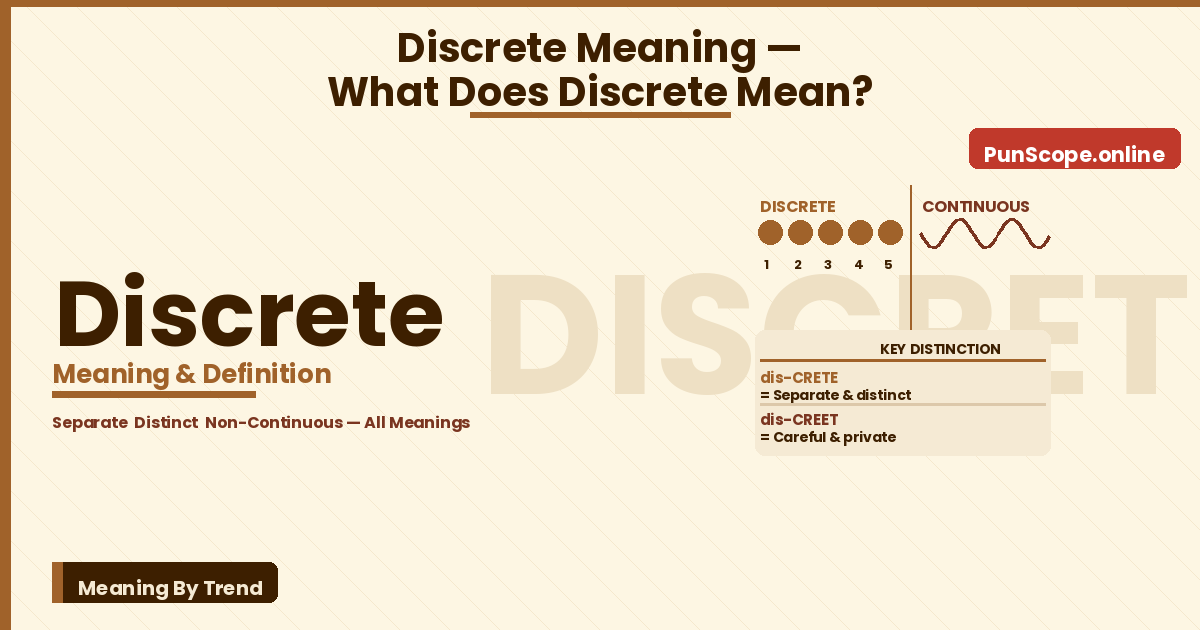
The word discrete is one of those precise and important English words that is frequently confused with its near-identical twin — discreet — yet carries a completely different and equally important meaning. Many people search for the discrete meaning because they are not entirely sure whether they want discrete or discreet, or because they have encountered the word in a mathematics, science, or academic context and want to understand exactly what it means. In most cases, discrete means individually separate and distinct — made up of clearly defined, non-overlapping parts or units that are separate from each other rather than forming a continuous whole.
This precise technical meaning makes discrete one of the most important words in mathematics, computer science, statistics, and many other academic and scientific disciplines. Whether you have encountered discrete in a maths textbook, a computer science lecture, an academic paper, or a confusing autocorrect moment, this complete guide will give you a thorough and precise understanding of the discrete meaning across every context in which this important and often misunderstood word appears.
Table of Contents
- What Does Discrete Mean in Text and Chat?
- Full Form, Stands For and Short Meaning of Discrete
- Origin, History and First Known Use of Discrete
- Discrete in Mathematics and Computer Science
- Discrete in Science and Statistics
- How People Use Discrete in Daily Conversations
- Discrete vs Discreet — The Most Important Distinction
- Discrete Across WhatsApp, Instagram, TikTok and Snapchat
- Different Meanings of Discrete in Other Fields
- Common Confusions, Mistakes and Wrong Interpretations
- Similar Terms, Alternatives and Related Words
- Examples of Discrete in Real Conversations
- FAQs
- Conclusion
What Does Discrete Meanung in Text and Chat?
In academic, scientific, and professional text messages and conversations, discrete means individually separate, distinct, and non-continuous — consisting of clearly defined, separate units or parts that do not blend or overlap with each other. Something discrete is made up of individually distinguishable elements that are each clearly bounded and separate from the others.
The word is particularly important in mathematics, computer science, statistics, physics, and linguistics — anywhere that a distinction needs to be made between things that exist as separate, countable units and things that exist on a continuous, unbroken spectrum or scale.
Discrete
adjective · Latin origin · discretus — separated, set apart
Discrete means individually separate and distinct — consisting of clearly defined, non-overlapping individual units or parts. Something described as discrete is made up of separate, identifiable elements that do not blend into each other. The word is the opposite of continuous — discrete things can be counted individually, while continuous things flow without clear separation between parts.
For example, in academic and technical conversations you might see:
“The data set consists of discrete values — each measurement is a whole number with no intermediate steps.”
“Discrete mathematics focuses on mathematical structures that are fundamentally separate and countable rather than continuous.”
“Each module is a discrete unit that can be studied and assessed independently from the others.”
Quick Chat Examples
Student 1: “Is this a continuous or discrete variable?” — Student 2: “Discrete — it can only take whole number values, nothing in between.”
“The program is broken into three discrete stages — completion of one is required before beginning the next.”
“Each packet of data is transmitted as a discrete unit — separate and complete in itself.”
Full Form, Stands For and Short Meaning of Discrete
Discrete
From Latin “discretus” — past participle of “discernere” — to separate, to distinguish
Discrete comes from the Latin discretus — the past participle of discernere, meaning to separate or to distinguish. This same Latin root gives us words like discern (to perceive or recognize), discerning (having good judgment), and discreet (careful and circumspect — the commonly confused near-homophone). All these words share the underlying idea of separation and distinction — making clear divisions between things.
Short Meaning
Discrete = Individually separate and distinct — consisting of clearly bounded, non-overlapping, countable individual units or parts rather than forming a continuous, unbroken whole.
Simple Definition
Think of discrete as the opposite of continuous. Water flowing in a river is continuous — there are no clear gaps or separation between one part of the water and the next. Individual water droplets falling as rain are discrete — each is a separate, distinct, individually bounded unit. Whenever something can be clearly counted or divided into clearly separate individual parts, it is discrete.
Synonyms of Discrete
Separate Distinct Individual Discontinuous Non-continuous Countable Isolated Segmented Independent Demarcated
Antonyms of Discrete
Continuous Connected Flowing Unbroken Overlapping Merged Blended Indistinguishable Analogue Infinite
Origin, History and First Known Use of Discrete
Language Timeline
| Period | Development |
|---|---|
| Classical Latin | “Discretus” — separated, set apart — past participle of discernere |
| Old French | “Discret” — enters French with both meanings (separate and cautious) |
| Late Middle English | Both discrete and discreet enter English — originally the same word |
| 17th–18th Century | The two spellings gradually diverge into separate words with distinct meanings |
| 19th Century | Discrete becomes firmly established in mathematical and scientific vocabulary |
| 20th Century | Discrete mathematics becomes a formal discipline — especially in computer science |
| 2026 | One of the most important technical terms in mathematics and computer science |
The word discrete comes from the Latin discretus — the past participle of the Latin verb discernere, meaning to separate, to sift, or to distinguish between things. This Latin root is also the source of the English word discern — to perceive or recognize clearly — and of discreet, the commonly confused near-homophone that means careful and circumspect.
Fascinatingly, discrete and discreet were originally the same word in English — both spellings appearing with both meanings in Middle English texts. The two spellings only gradually diverged into distinct words with distinct meanings over the course of the seventeenth and eighteenth centuries — a process of differentiation that helped the language make a clear distinction between two related but importantly different concepts.
Discrete in Mathematics and Computer Science
The word discrete is most commonly and importantly encountered in the context of mathematics and computer science, where it describes mathematical structures, values, and systems that consist of separate, countable, non-continuous elements.
Discrete Mathematics
Discrete mathematics is a major branch of mathematics that studies mathematical structures that are fundamentally discrete — that is, structures made up of separate, countable elements rather than continuous quantities. Discrete mathematics is the foundation of computer science and includes the study of logic, sets, graphs, trees, algorithms, combinatorics, number theory, and many other topics that are essential to the functioning of digital computing.
Unlike calculus — which deals with continuous functions and infinitely small changes — discrete mathematics deals with finite or countably infinite structures where every element is clearly separate and distinct from every other element. This makes it the natural mathematical language for computer science, where data is processed and stored in discrete units.
Discrete vs Continuous Variables
In mathematics and statistics, one of the most fundamental distinctions is between discrete variables and continuous variables. A discrete variable is one that can only take specific, separate values — typically whole numbers — with no possible values in between. A continuous variable can take any value within a range — including all possible decimal values between any two points.
| Type | Definition | Examples |
|---|---|---|
| Discrete variable | Can only take specific separate values — usually integers | Number of children, dice roll, number of cars |
| Continuous variable | Can take any value in a range — including all decimals | Height, weight, temperature, time |
Discrete Data
Discrete data is data that can only take specific, separate values — typically whole numbers that can be counted individually. The number of students in a classroom, the number of goals scored in a football match, the number of cars in a car park — all of these are discrete because they can only be whole numbers. You cannot have 2.7 students or 1.5 goals — each value is a clearly separate, individually countable unit.
Digital Technology and Discrete Mathematics
The entire foundation of digital computing rests on the discrete nature of binary data. Digital computers store and process information as discrete binary values — 0s and 1s — rather than as continuous analogue signals. This is why computer science is so deeply rooted in discrete mathematics — and why the word discrete is one of the most important and frequently encountered terms in the computer science vocabulary.
Discrete in Science and Statistics
Beyond mathematics and computer science, discrete appears as an important technical term across many scientific disciplines.
Discrete in Physics
In physics, the concept of discrete quantities is central to quantum mechanics — one of the most important and revolutionary developments in the history of physics. Quantum mechanics revealed that energy, at the subatomic level, does not flow continuously but instead exists in discrete packets called quanta. The quantization of energy — the discovery that it comes in discrete, indivisible units — was one of the founding insights of modern physics and earned Max Planck the Nobel Prize in 1918.
Discrete in Statistics
In statistics, the distinction between discrete and continuous probability distributions is fundamental to statistical analysis. A discrete probability distribution assigns probabilities to specific, separate values — such as the probability of getting exactly 3 heads in 10 coin flips. A continuous probability distribution assigns probabilities across a range of values that can take any real number — such as the probability that a randomly selected person’s height falls within a certain range.
Discrete in Linguistics
In linguistics, language is often described as a system of discrete units — individual phonemes, morphemes, words, and sentences that are each clearly bounded and distinct from each other. The discreteness of linguistic units is one of the fundamental design features of human language that distinguishes it from other forms of animal communication.
How People Use Discrete in Daily Conversations
1. In Academic and Educational Contexts
“Make sure you understand the difference between discrete and continuous data before the statistics exam.”
“The course is divided into six discrete modules, each with its own assessment and learning objectives.”
2. In Professional and Business Contexts
“The project has been broken into discrete phases — phase one must be signed off before phase two begins.”
“Each team operates as a discrete unit with its own budget, objectives, and reporting structure.”
3. In Technical and Computing Contexts
“Digital audio converts continuous sound waves into discrete samples — typically 44,100 per second for CD quality.”
“The algorithm processes inputs as discrete integer values rather than continuous floating-point numbers.”
Discrete vs Discreet — The Most Important Distinction
The single most important thing to understand about the word discrete is how it differs from its near-identical near-homophone discreet — two words that share the same Latin root, sound almost identical when spoken, and are confused with each other constantly even by highly educated native English speakers.
| Word | Meaning | Example | Memory Tip |
|---|---|---|---|
| Discrete | Individually separate and distinct — made of non-overlapping parts | “The data exists as discrete values.” | The E’s are separated by other letters — just like discrete things are separated |
| Discreet | Careful, tactful, and circumspect — keeping things private or confidential | “Please be discreet about what I told you.” | The E’s are together at the end — just like discreet people keep things close together and private |
A Useful Memory Trick
One of the most popular memory tricks for keeping these words apart focuses on the spelling. In disCREte, the two E’s are separated by other letters — just as discrete things are separate and distinct. In discrEEt, the two E’s are right next to each other at the end — just as a discreet person keeps information close and does not let it spread around. This visual mnemonic has helped millions of students reliably distinguish between these two commonly confused words.
Common Mistake Examples
WRONG: “Please be discrete about our conversation.” (Should be: discreet — meaning careful and private)
WRONG: “The data points are discreet values.” (Should be: discrete — meaning separate and distinct)
CORRECT: “The survey collected discrete data points that were analyzed statistically.”
CORRECT: “I trust you to be discreet about the information I have shared with you.”
Discrete Across WhatsApp, Instagram, TikTok and Snapchat
Most commonly appears in academic group chats, study groups, and professional conversations where the technical meaning is relevant.
Example: “For the stats assignment — remember shoe size is discrete data, height is continuous. Don’t mix them up.”
Twitter/X and LinkedIn
Appears in educational content, academic discussions, and professional posts about data science, mathematics, and computer science.
Example: “One of the most fundamental distinctions in data science: knowing whether your variable is discrete or continuous before you start analyzing it.”
TikTok
Educational TikTok — particularly maths, statistics, and study-tips content — frequently uses discrete and often explains the discrete vs discreet distinction.
Example: “If you always confuse discrete and discreet — watch this and you will never get them wrong again.”
YouTube
Discrete appears extensively in educational YouTube content — mathematics tutorials, computer science lectures, statistics guides, and study skill videos.
Different Meanings of Discrete in Other Fields
| Field | How Discrete Is Used | Example |
|---|---|---|
| Mathematics | Non-continuous, countable mathematical structures | “Discrete mathematics is the foundation of computer science.” |
| Statistics | Variables or data that take specific separate values | “Number of goals scored is a discrete variable.” |
| Computer Science | Digital, binary, or individually bounded data and processes | “Digital computers process discrete binary values.” |
| Physics | Quantized, non-continuous energy or matter | “Energy exists in discrete quanta at the subatomic level.” |
| Linguistics | Individually bounded language units | “Human language consists of discrete phonemes and morphemes.” |
| Project Management | Clearly separate, individually bounded project phases or tasks | “The project is organized into discrete deliverables.” |
Common Confusions, Mistakes and Wrong Interpretations
1. The Discrete vs Discreet Confusion
The single most common mistake involving discrete is using it when discreet is intended — or vice versa. This confusion is so common that it appears regularly even in published writing from educated authors. The key is simply to remember that discrete means separate and distinct, while discreet means careful and private. When in doubt, ask yourself whether you are talking about separate parts (discrete) or careful behavior (discreet).
2. Thinking Discrete Only Applies to Numbers
While discrete is most commonly encountered in mathematical and statistical contexts involving numbers, it applies much more broadly to any situation where clearly separate, individually distinct elements or units are being described. A project with distinct phases is discrete. A set of clearly separate categories is discrete. Any collection of clearly bounded, non-overlapping, individually distinguishable things can be described as discrete.
3. Confusing Discrete with Digital
In technology contexts, discrete and digital are closely related but not identical. Digital specifically refers to representing information using discrete binary values (0s and 1s). Discrete is a broader concept that includes digital but also encompasses any system or set of values made up of separate, individually distinct elements — not necessarily binary.
4. Thinking Discrete Means Small or Hidden
Some people confuse discrete with discreet and assume discrete means inconspicuous, small, or hidden. Discrete has nothing to do with size or visibility — it means separate and distinct. A very large, highly visible object can be discrete if it is clearly bounded and separate from everything around it.
Similar Terms, Alternatives and Related Words
| Word | Meaning | Key Difference from Discrete |
|---|---|---|
| Discrete | Individually separate and distinct | The core term — separate, countable, non-continuous |
| Separate | Not joined or connected | Less technical — broader everyday use |
| Distinct | Clearly different or recognizably separate | Emphasizes difference rather than separation |
| Individual | Single, separate from others | Focuses on singleness rather than systematic separation |
| Discontinuous | Not continuous — having breaks or gaps | More specifically emphasizes the absence of continuity |
| Quantized | Existing in discrete units (physics) | Specific to physics and quantum mechanics contexts |
Examples of Discrete in Real Conversations
“Number of siblings is a discrete variable — you cannot have 1.5 siblings. Height is continuous.”
“The course is divided into discrete modules — you must pass each one before progressing to the next.”
“Digital audio works by converting continuous sound waves into discrete samples at regular intervals.”
“In discrete mathematics, we study graphs, trees, and algorithms that operate on clearly separate elements.”
“The data points are discrete — they can only be whole numbers between 1 and 10.”
“Each country’s legal system is a discrete entity with its own laws, courts, and procedures.”
“Quantum mechanics revealed that energy exists in discrete packets rather than flowing continuously.”
“The project is organized into five discrete phases — planning, design, build, test, and launch.”
Quick Scenario
Student: “I keep mixing up discrete and discreet — which one do I use for separate data values?” — Teacher: “Discrete — with the separated E’s — for separate data. Discreet — with the E’s together — for keeping secrets. The spelling tells you the meaning!”
FAQs
What does discrete mean in simple words?
In simple words, discrete means individually separate and distinct — made up of clearly defined, non-overlapping individual parts or units. Something discrete can be counted as separate items — like individual numbers, separate project phases, or distinct data points. It is the opposite of continuous — which flows without clear separation between parts. Discrete is not the same as discreet, which means careful and tactful.
What is the difference between discrete and discreet?
Discrete means individually separate and distinct — used in mathematics, science, and academic contexts. Discreet means careful, tactful, and circumspect — keeping things private and avoiding unnecessary attention. They come from the same Latin root but have developed completely different meanings. A useful memory tip: in discrete, the E’s are separated — like discrete things. In discreet, the E’s are together — like keeping things close and private.
What is discrete data?
Discrete data is data that can only take specific, separate values — typically whole numbers that can be counted individually. Examples include the number of students in a class, goals scored in a match, or cars in a car park. Discrete data is contrasted with continuous data — which can take any value within a range, including all possible decimal values. Height and weight are continuous — you can always measure more precisely.
What is discrete mathematics?
Discrete mathematics is a major branch of mathematics studying mathematical structures made up of separate, countable elements rather than continuous quantities. It includes the study of logic, sets, graphs, algorithms, combinatorics, and number theory. Discrete mathematics is the mathematical foundation of computer science — digital computers work with discrete binary values, making discrete mathematical structures the natural language for computer science and programming.
Is discrete formal or informal?
Discrete is primarily a formal and technical term — most commonly used in academic, scientific, mathematical, and professional contexts. Unlike its near-homophone discreet, which is used freely in everyday conversation, discrete rarely appears in casual informal speech. When people want to say “separate” or “distinct” in everyday conversation, they typically use those simpler words — discrete is reserved for contexts where its precise technical meaning is needed.
Conclusion
The word discrete is one of those precise and important technical terms that does specific and essential work across mathematics, computer science, physics, statistics, and academic writing — work that simpler words like separate or distinct cannot do with the same precision and authority. Whether describing discrete data points in a statistics analysis, discrete mathematical structures in a computer science course, discrete energy quanta in quantum physics, or discrete project phases in professional project management, the word discrete provides a level of conceptual clarity that is genuinely valuable.
Understanding the complete discrete meaning — including the crucial distinction from its near-twin discreet, the memory tricks that help keep them apart, and the many technical contexts in which discrete appears — gives you not just a word but a precise and powerful conceptual tool for thinking and communicating about the fundamental difference between things that are separately countable and things that flow continuously without clear division.